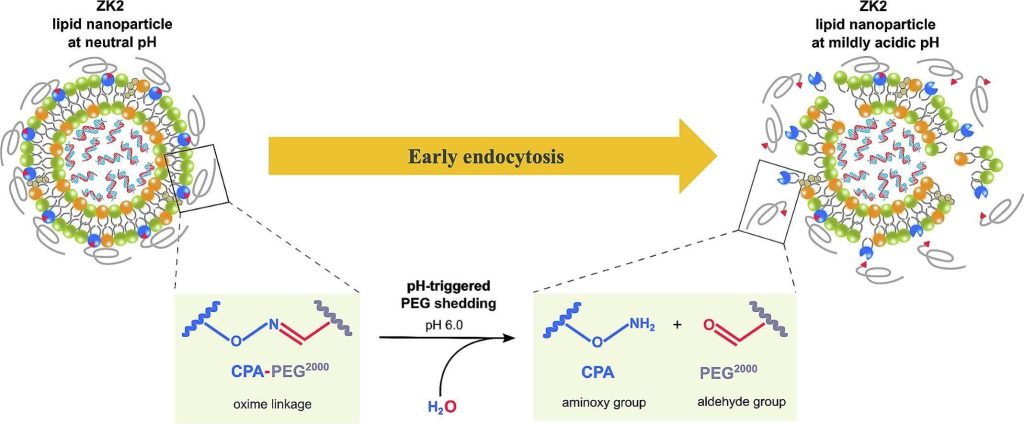


Researchers from Mendel University in Brno, Brno University of Technology (TU Brno) and others have developed a new approach to improving the efficiency of RNA delivery to disease target cells. The work was carried out within the NanoPrecMed framework and addresses one of the major challenges in RNA-based medicine: getting RNA to the right place inside target cells to be effective.
Researchers from Mendel University in Brno, Brno University of Technology (TU Brno) and others have developed a new approach to improving the efficiency of RNA delivery to disease target cells. The work was carried out within the NanoPrecMed framework and addresses one of the major challenges in RNA-based medicine: getting RNA to the right place inside target cells to be effective.
RNA molecules such as siRNA can be used to specifically reduce the activity of certain genes. However, delivering RNA into cells is challenging. To protect and transport the fragile molecules, researchers often use lipid-based nanoparticles (LNPs) — tiny particles made mainly from lipids that act as delivery vehicles.
Once an LNP enters a target cell, it is taken up into a small membrane-bound compartment called an endosome. The LNP and its RNA cargo can become trapped there. However, if endosomal escape is triggered then the RNA can enter the cytoplasm of target cells where it is biologically active.
The researchers report on the development of a new type of triggered LNP system called ZK2, which is designed to respond to the acidic pH environment inside endosomes. As the pH decreases, ZK2 LNPs shed part of their outer coating and undergo other structural changes that combine to trigger disruption of the endosomal membrane, so promoting the release of RNA cargoes into cytoplasm.
The researchers showed that ZK2 LNP-mediated triggered release improves RNA release and functional delivery of siRNA in cell experiments, using a hepatitis B virus (HBV) infection model, resulting in effective and prolonged HBV gene silencing.
The study highlights the value of collaboration between Mendel University and TU Brno within NanoPrecMed, bringing together expertise in nanoparticle design, chemistry and biological research.
Publication: