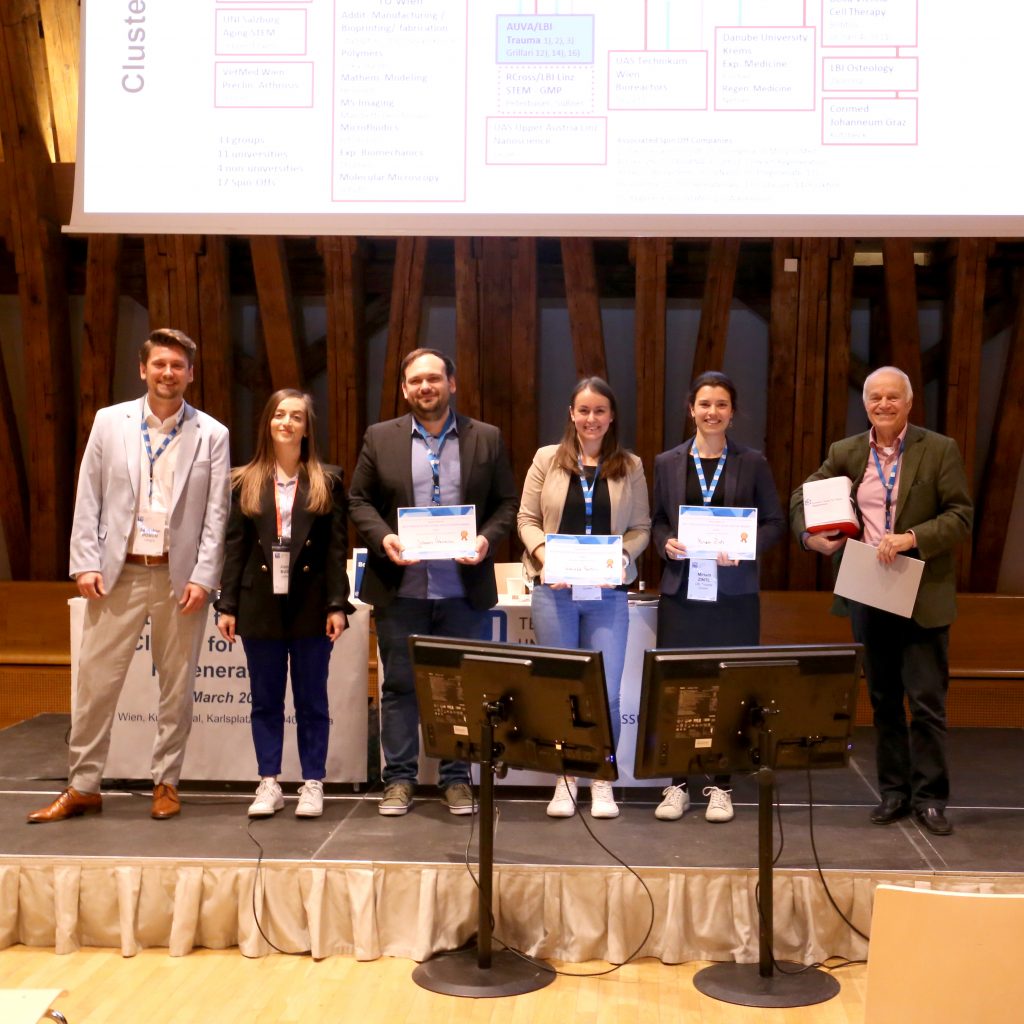
Johannes Oesterreicher from LBI Trauma has been awarded the Young Investigator Award at the 19th Annual Meeting of the Austrian Cluster for Tissue Regeneration at TU Vienna. His exceptional presentation was recognized for its innovative approach to overcoming a major safety concern in extracellular vesicle (EV) research.
Advancing the Safety of EV-Based Therapies
Extracellular vesicles are a promising tool in regenerative medicine, offering the potential to deliver targeted therapies with high precision. However, preclinical studies with EVs derived from mesenchymal stromal cells, point towards a significant challenge: the risk of triggering blood clot formation due to the presence of a key protein involved in the coagulation cascade. If not properly controlled, this unintended pro-thrombotic effect could lead to severe complications, including life-threatening thrombotic events. The project of Johannes Oesterreicher aimed to generate a cell line that does not pose the risk of thrombogenicity when used to generate therapeutic EVs.
Using CRISPR/Cas9 gene editing, the team successfully created a TF knockout adipose-derived stromal cell line. Expression analysis confirmed the successful deletion of the gene coding for TF, without altering other important cell characteristics. The EVs derived from these modified cells retained their beneficial biological properties and show no changes in immune-modulating effects or lineage-specific markers. More importantly, thromboelastometric analysis demonstrated a significant reduction in clotting potential, confirming that TF-knockout-derived EVs eliminate the thrombogenic risk associated with conventional EV preparations.
This research represents an important step forward in ensuring the safety of EV-based therapeutics. By successfully engineering EVs that do not pose a clotting risk, this work brings us closer to developing clinically viable EV therapies for regenerative medicine and beyond.
The Austrian Cluster for Tissue Regeneration: A Hub for Innovation
The Austrian Cluster for Tissue Regeneration is a leading research network uniting top institutions all over Austria. Its mission is to advance soft tissue, cartilage, bone, and neuro regeneration, translating research into better treatments. In 2025, the Cluster includes 33 research groups, fostering collaboration through shared infrastructure, material exchange, and annual scientific meetings. Supported by the Austrian Society for Tissue Regeneration, it plays a key role in driving biomedical innovation.
As a Strategic Partner of the NanoPrecMed project, the Cluster’s expertise in tissue regeneration aligns with the mission of advancing nanotechnology-based solutions for precision medicine. The collaboration between biochemists, engineers, molecular biologists, and clinicians creates a unique research environment where new discoveries – such as those by Johannes Oesterreicher – can quickly transition from scientific breakthroughs to real-world applications.
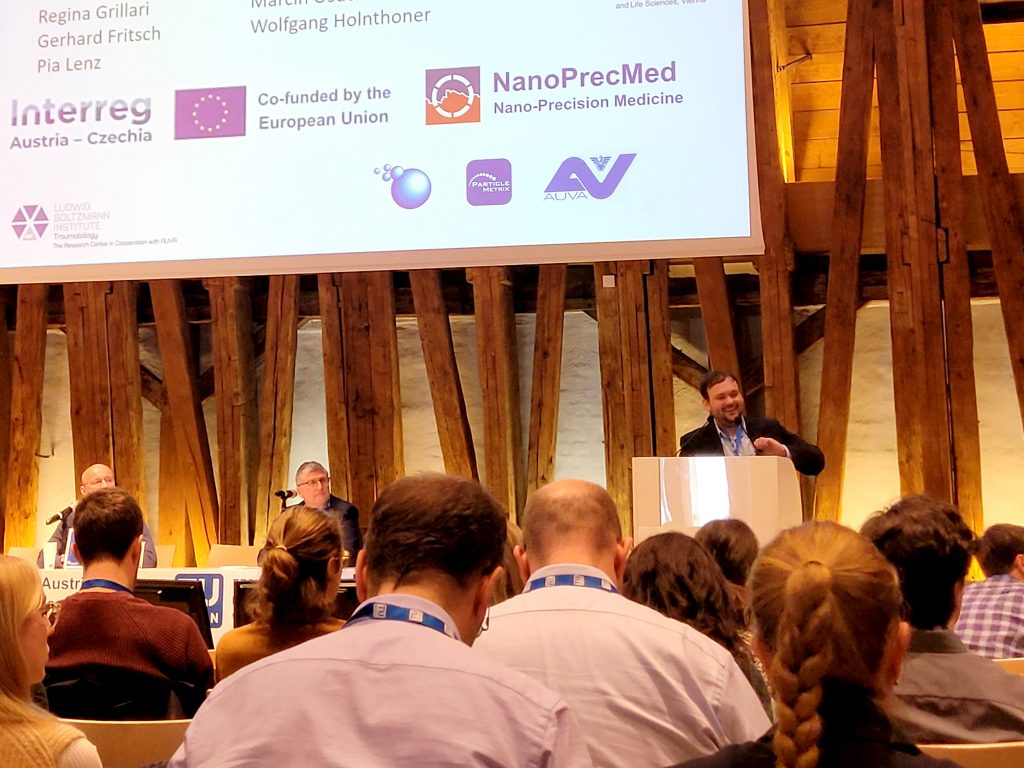
A Well-Deserved Recognition
This Young Investigator Award not only acknowledges Johannes Oesterreicher’s exceptional contribution to EV research but also underscores the importance of ensuring safety in next-generation regenerative therapies. His work sets a new standard for the development of EV-based treatments, opening doors for their safe and effective clinical application.