



What if we could build surfaces with nanometer precision – using DNA as a construction material? Our NanoPrecMed Consortium partners at Johannes Kepler University (JKU) Linz have taken an exciting step in that direction. In their latest publication, they describe how they created highly organized DNA nanostructure arrays that cover entire surfaces while offering attachment points for functional molecules.
DNA might be known as the carrier of genetic information, but thanks to its predictable pairing rules, it’s also a versatile building block. By designing DNA strands to self-assemble into specific shapes, the team was able to grow complex crystal structures that stand upright from a surface, like molecular “pins” ready for action.
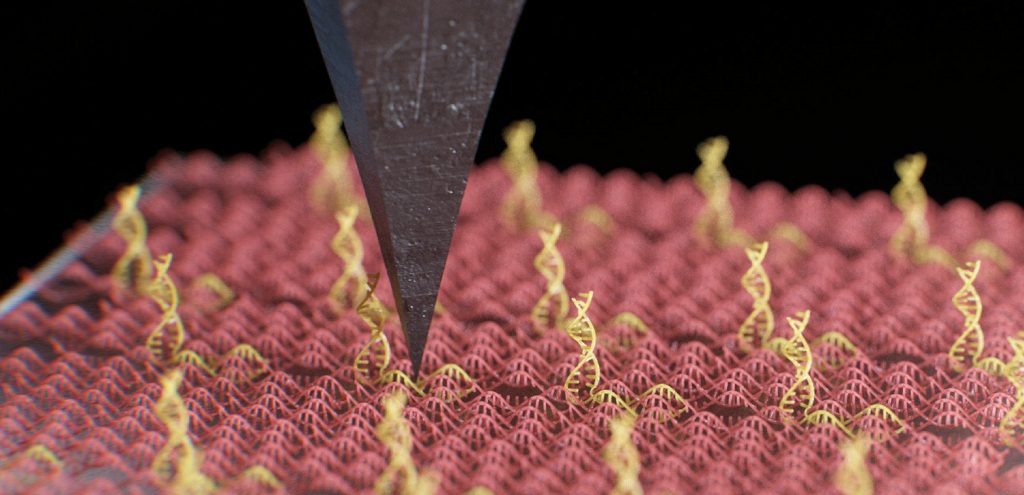
These vertical DNA structures can then be precisely functionalized, for example by attaching aptamers, which are short DNA or RNA strands that fold into specific shapes to tightly bind target molecules such as proteins. Aptamers act like molecular “Velcro,” making them useful tools for detecting biomolecules with high precision. The result: large-scale sensor surfaces with nanoscale precision.
To achieve this, the researchers lead by Yoh Jin Oh and Peter Hinterdorfer, developed a new method that carefully controls how the DNA structures are assembled and anchored to the surface. Using atomic force microscopy (AFM), they confirmed that their technique leads to uniform coverage and consistent spacing, crucial for applications in biosensing, diagnostics, and smart materials.
The cover art of the recent issue of ACS Nano, where the study was published, reflects this achievement: a conceptual visualization of vertical DNA nanostructure arrays, uniformly anchored on a surface and ready for functionalization. It highlights how the smart design of repeating unit tiles enables control over spatial arrangement at the nanometer level.
By bridging the nano and macro worlds, this study paves the way for scalable, highly defined biofunctional surfaces and shows what is possible when nanotechnology meets molecular precision.
Read the full paper in ACS Nano: Vertical DNA Nanostructure Arrays: Facilitating Functionalization on Macro-Scale Surfaces